
Arrest History in DuPage County
Arrests in DuPage can begin with the DuPage County Sheriff, Illinois State Police, or a municipal force such as Naperville, Wheaton, Downers Grove, Elmhurst, Lombard, Carol Stream, Glendale Heights, Addison, Bloomingdale, or Bartlett police. The agency that makes the arrest owns its report. If a person is lodged in the county Correctional Center, the Sheriff creates the booking and custody record. When prosecutors file a complaint, information, indictment, citation, or other charging document, the Circuit Clerk opens a court file. ISP receives fingerprints and arrest-event identifiers for reportable events.
Those documents are related, but none is a full substitute for the others. The police report describes the event and alleged basis for arrest. A booking entry proves that intake occurred. The court file shows what prosecutors actually filed and how the judge resolved the case. ISP criminal-history information connects reported Illinois arrest cycles with outcomes received from courts and justice agencies. No reliable official source states that the public county custody interface provides a complete historical date range. It should be used as a recent-custody tool, not as an all-time arrest archive.
DuPage Arrest Custody Search
The DuPage Sheriff inmate search is the most direct official starting point for someone who may now be held in county custody. Search controls can change, but the interface is built around identifying fields such as last and first name, with a booking or subject identifier when offered. A result may include a booking number, booking date, custody status, charges, release or pretrial information, and facility details. It covers county custody, mainly pretrial detention and shorter local sentences. It does not replace the IDOC Individuals in Custody search for a person committed to state prison or the federal locator for federal custody.
Release, transfer, a spelling mismatch, delayed entry, or an arrest that did not lead to county lodging can all produce an empty search. Disappearance from the current roster does not erase the booking. For notifications about later custody changes, VINELink shows the custody-notification service used by Illinois agencies.
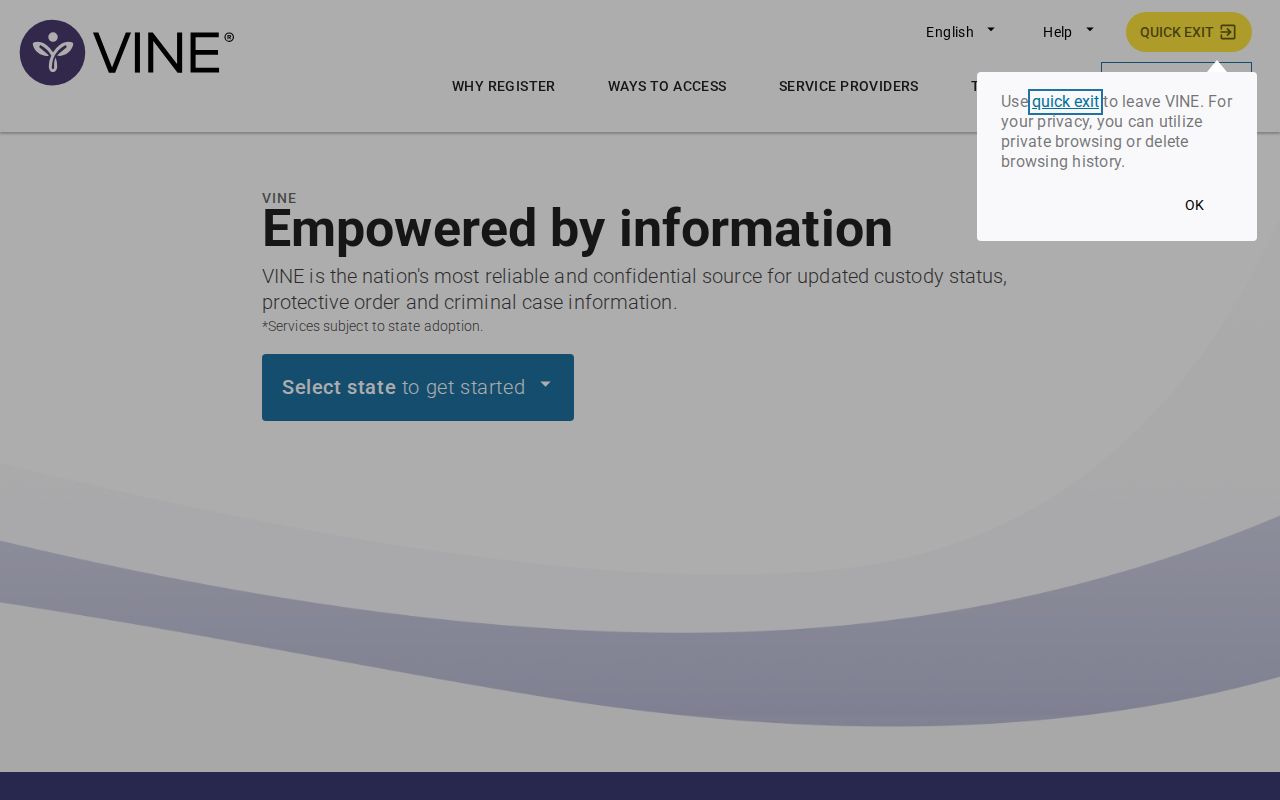
VINELink can help track custody status, but it is not a certified arrest-history product and should not be read as one.
How to Look Up DuPage County Arrests
Begin with the question the record must answer. Current county detention belongs with the Sheriff. The arrest narrative belongs with the arresting department. Filed charges and outcomes belong with the Circuit Clerk. A statewide review of one's own record belongs with ISP. Use a full legal name, approximate date and place, arresting agency, and report, booking, complaint, or case number whenever available.
- Check the Sheriff inmate interface for current county custody, then use IDOC for state prison or the federal locator when the custody type points elsewhere.
- Ask the arresting agency for its arrest or incident report. Ask the Sheriff separately for booking material if county intake occurred.
- Search the 18th Judicial Circuit Clerk by case or complaint number, or by full last name narrowed with first name, middle name, and birth date.
- For one's own statewide identity-linked history, use ISP fingerprint Access and Review. A prescribed UCIA inquiry is the public conviction-information channel.
- When a web search fails, submit a focused Illinois FOIA request to the agency that created the record, or call first to confirm the correct custodian.
A municipal arrest may require both a city police request and a Sheriff booking request. Naperville also crosses the DuPage and Will county line, so use the incident location rather than the mailing city alone to select the correct jail and circuit clerk.
Four DuPage Arrest Records
A single event can yield four records with different facts and dates. The municipal or Sheriff report records the officer's account and alleged legal basis. County corrections records intake, fingerprints, property, holds, and custody status. The State's Attorney may select different counts, decline filing, or seek detention. Only then does the Circuit Clerk record what was filed. ISP later associates qualifying arrest fingerprints with reported dispositions. That flow explains why the charge at arrest may differ from the court charge.
| Source | Best Question |
|---|---|
| Arresting police agency | What did the officer report? |
| DuPage Sheriff booking | Was the person lodged in county custody? |
| 18th Judicial Circuit Clerk | What charge was filed and how did it end? |
| ISP Bureau of Identification | What Illinois arrest cycles and outcomes are linked to the subject? |
Record the source and search date with any field copied from a live system. Custody and release data can change, while the allegation may be replaced by a different filed count.
Timing, rejected fingerprints, aliases, mismatched identifiers, delayed outcomes, sealing, expungement, and agency errors can cause gaps. Match identifiers and obtain the newest signed court order instead of forcing the sources into a false single story.
What an Arrest Record Shows
A DuPage arrest report can show the report number, event date and place, arresting agency, warrant or warrantless authority, alleged statutes, narrative, evidence, and transport details. The booking record focuses on identity and custody. Public fields vary, and sensitive medical, classification, victim, juvenile, and security information may be withheld. Even when a booking photograph exists, Illinois law and the applicable exemption review control public release.
| Booking Number | The county intake identifier used to distinguish a custody event and request the correct booking file. |
|---|---|
| Booking Date & Time | When corrections processed intake, which may differ from the time of arrest. |
| Arresting Agency | The department that owns the arrest report, even if the Sheriff later held the person. |
| Charges | Allegations or holds recorded at intake; these may not match the counts later filed in court. |
| Bond | Historical records may use cash-bond terms. Current Illinois records should be read through the signed pretrial release or detention order. |
| Mugshot Policy | A photograph may be taken at booking, but public release is not guaranteed and remains subject to law, redaction, and agency review. |
| Release Status | Whether custody continues or release was processed; it does not state the final court outcome. |
DuPage County Arrest Booking
After transport, corrections staff confirm identity and legal authority, inventory property, conduct immediate health screening, and assign a booking number. Fingerprints and a photograph are captured where required. Staff enter charges and holds, while the state receives fingerprint data for reportable events. The process then moves toward pretrial assessment and first appearance. A judge decides release conditions or detention under Illinois's current cashless-pretrial system.
Old dockets can still contain cash-bond language. That history does not describe every current case. A detention petition is a prosecutor's request, not the judge's result. Read the signed release or detention order and the newest docket event. Booking staff record the authority then supplied; prosecutors can later amend the counts, reject filing, or request more investigation.
Recent Arrests and Booking Logs
No durable official daily booking-log URL was verified in the county research. The Sheriff inmate interface is the official recent-custody proxy. It may show identifying and booking fields, charges, pretrial or release information, and facility status. Official agency news releases are selective. They are not a complete blotter, and their allegations are not findings of guilt.
Current-custody rosters change as people are released or transferred. An absent name might reflect a release, transfer to IDOC, spelling variation, delayed entry, or an arrest without county booking. It proves neither that no arrest happened nor that a past entry was erased. For a historical booking, identify the date and booking number and request the Sheriff's existing, non-exempt material. For a filed outcome, search the Clerk instead.
Request DuPage Arrest Material
DuPage County's FOIA routing page identifies the county request path. Direct a Sheriff arrest or booking request to the Sheriff, but send a Naperville, Wheaton, Downers Grove, or other municipal police report request to that city or village. Include the incident date range, place, report or booking number, subject, desired electronic format, and contact details. Ask for non-exempt portions. Phone contact can confirm the custodian, but a phone answer is not a certified record.
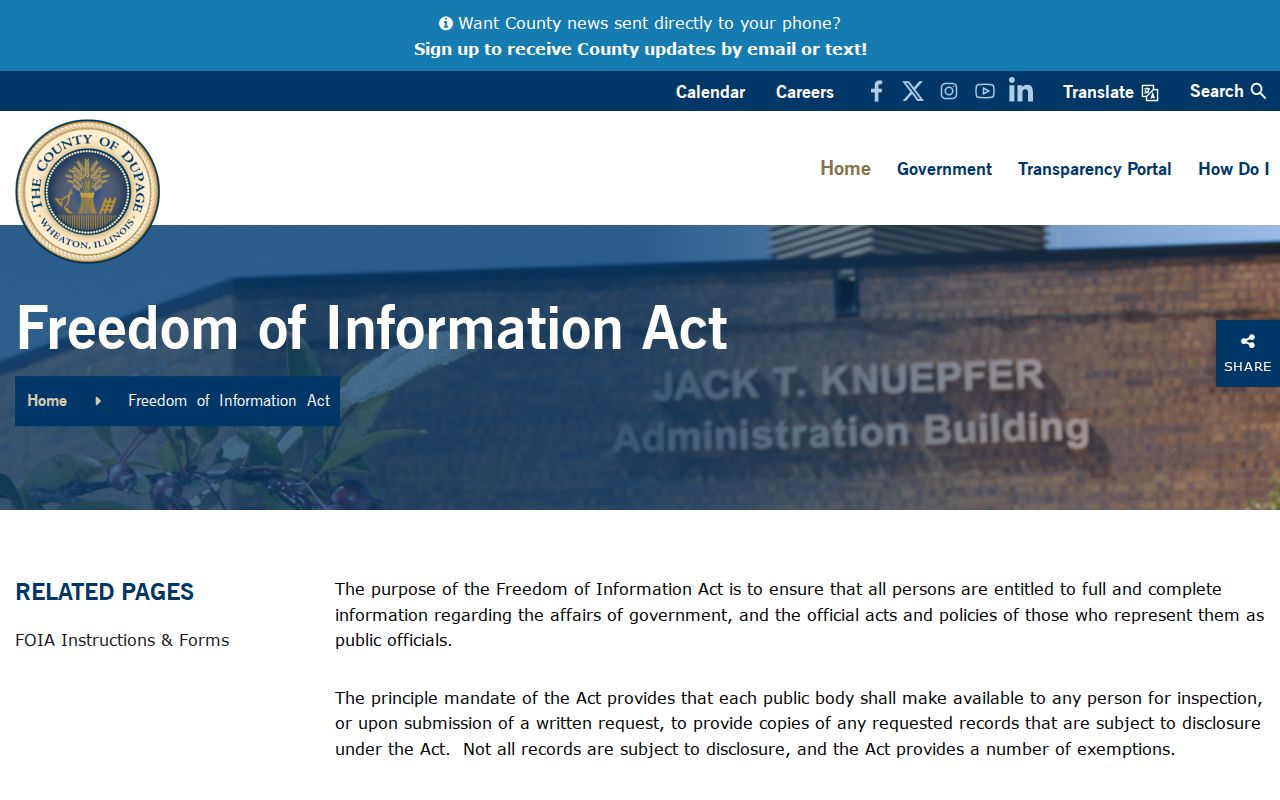
The county routing screen matters because one campus and one arrest can still involve several legal custodians.
Illinois FOIA ordinarily sets a five-business-day response baseline for noncommercial requests, with permitted extensions. It does not guarantee production by day five. An agency may redact protected parts, cite an exemption, seek clarification, state that it has no responsive file, or point to another custodian. A denial must state the exemption and appeal rights. Public Access Counselor review is available within 60 calendar days. Court pleadings are obtained under Clerk procedures, not by using FOIA to bypass a sealed or impounded case.
DuPage County Sheriff Records
Custody and Sheriff-created files
County Farm Road government campus
Wheaton, Illinois
Confirm the current records or corrections contact with the Sheriff before visiting or sending a request.
Correct DuPage Arrest History
For self-review, ISP fingerprint Access and Review is the authoritative correction path. An Illinois law-enforcement or correctional facility or an Illinois-licensed fingerprint vendor can capture and transmit the prints. Vendor sites, appointments, and charges change, so confirm them through the official list.
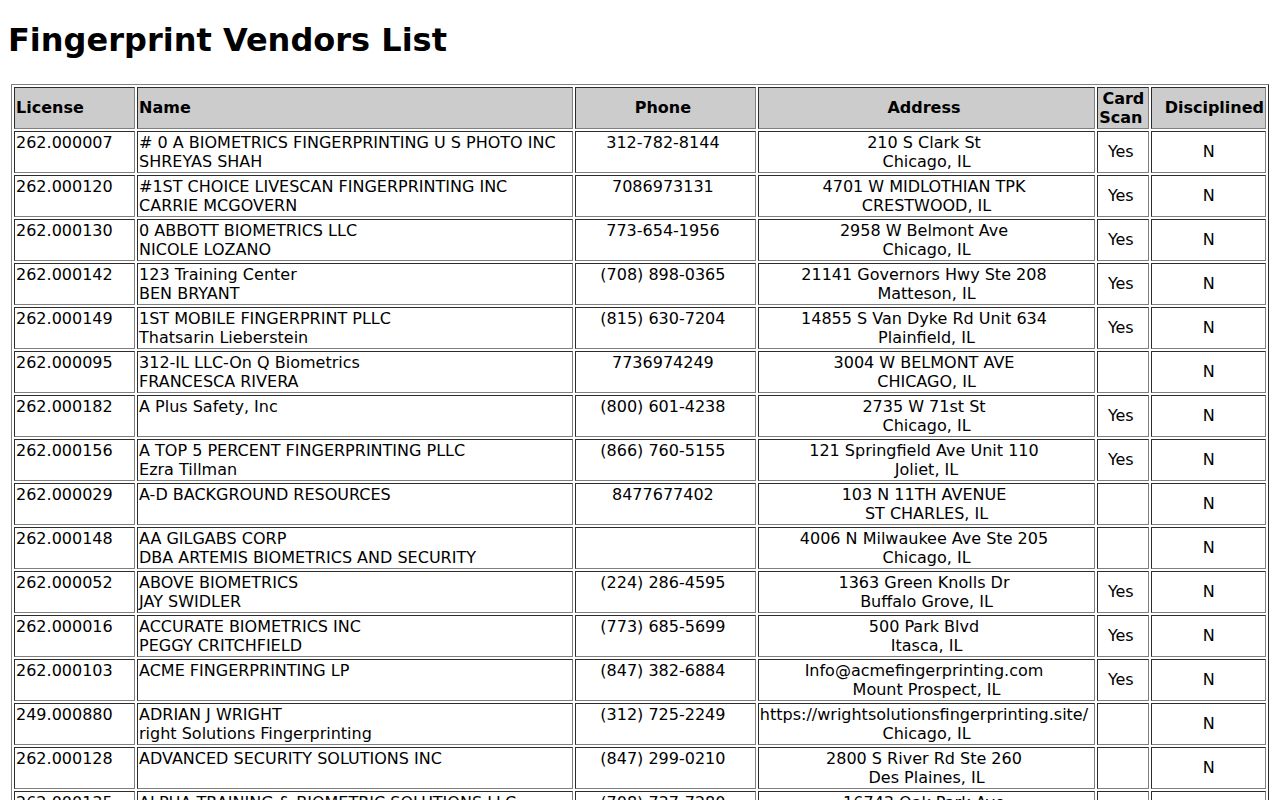
The vendor list is a routing source, not an endorsement of a fixed DuPage location or price.
ISP explains Access and Review and the Record Challenge process. ISP mails a transcript with a challenge form, or a no-record letter. ISP charges no Access and Review fee, although the fingerprint provider may charge for capture and transmission.
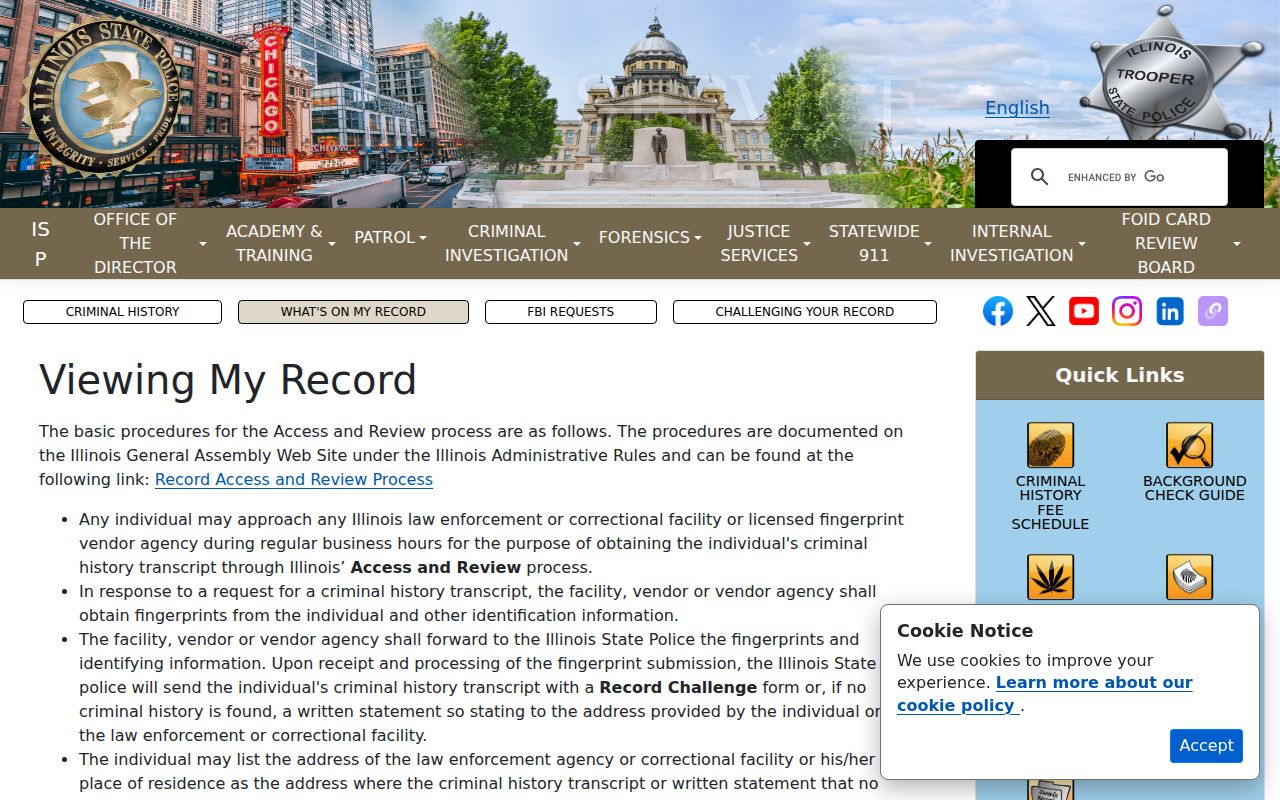
If a disposition is wrong or missing, obtain a certified disposition from the Circuit Clerk and identify the exact arrest cycle or identity error on the challenge. Do not guess from an unresolved booking entry.
Public conviction information under the Uniform Conviction Information Act is a separate product. The ISP fee schedule distinguishes electronic, paper, and fingerprint inquiry charges.
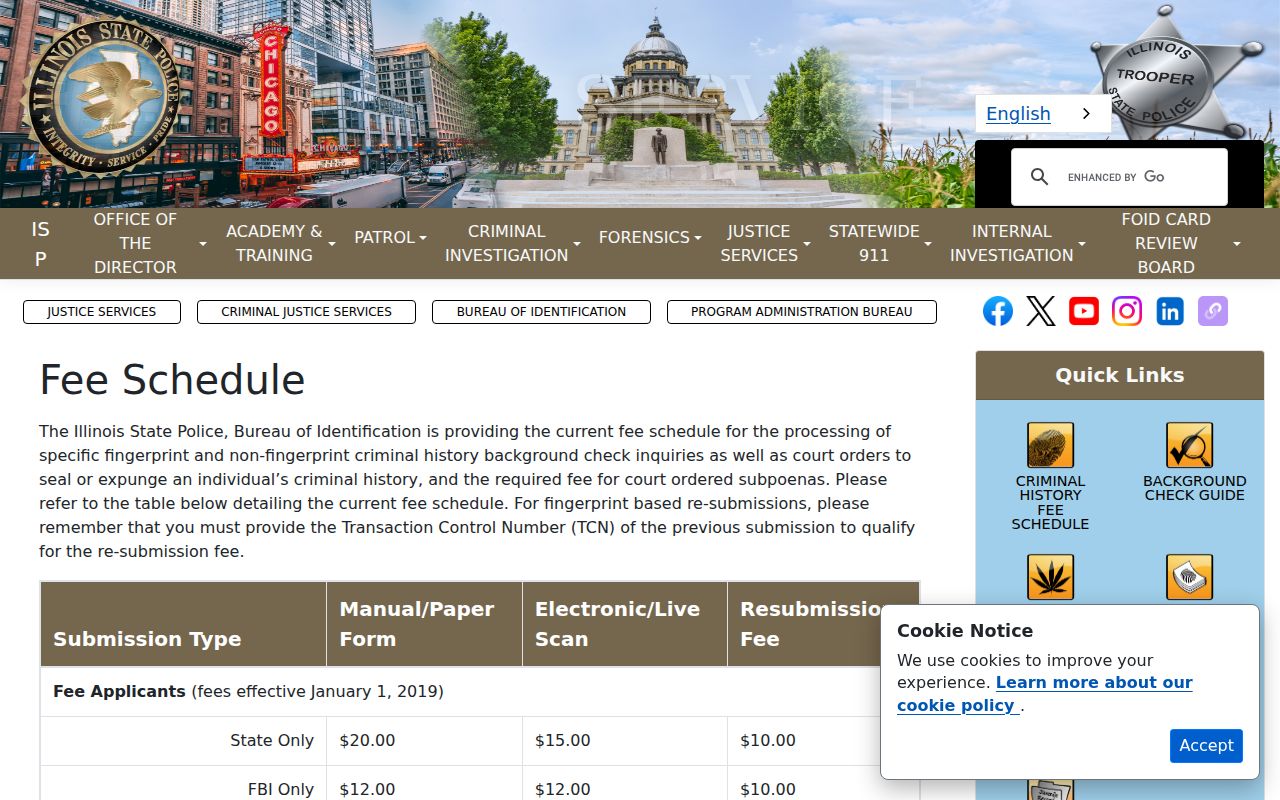
As of the research date, UCIA name inquiries were $10 electronically or $16 on paper, excluding vendor costs. A same-name response is less reliable than fingerprints and is not the subject-only Access and Review transcript.
Arrests vs Convictions
An arrest records probable cause and custody. A conviction follows a court judgment. Different agencies create the records, and a booking can remain even when prosecutors file no charge or a court dismisses or acquits. Conversely, a court case can proceed from a citation without a county jail stay. The final disposition must come from the Clerk's docket and signed order, not from the intake charge.
| Arrest Record | Conviction Record |
|---|---|
| Created by the arresting agency and, after lodging, county corrections. | Created through a judgment in the Circuit Court. |
| Shows that an arrest or booking occurred, not guilt. | Shows a court finding or accepted plea of guilt. |
| Lives with the police agency and Sheriff booking system; reportable events also reach ISP. | Lives with the Circuit Clerk; qualifying outcomes are reported to ISP. |
| May be followed by release, no filing, dismissal, acquittal, or a filed case. | May be followed by sentence, appeal, or eligible expungement and sealing procedures. |
Note: An arrest is not proof of guilt. Some bookings lead to no filed charge, dismissal, or acquittal.