
How to Check Criminal History in Naperville
A reliable Naperville records check follows the event from city report to county filing. Do not begin with a broad name match if the police incident number or court case number is known. Exact identifiers reduce the chance of mixing two people or crossing the county line by mistake.
- Confirm the incident location and whether it lies in DuPage or Will County. Keep the NPD report number if one exists.
- Ask Naperville Police Records for the city incident or arrest report. List the date, place, subject, and desired parts of the file.
- Check the jail for the county that received the person. A missing current-custody result may mean release, transfer, or no jail booking.
- Search the correct circuit clerk. DuPage-side state charges use the Eighteenth Judicial Circuit; Will-side matters do not become DuPage cases.
- For one's own statewide transcript, use fingerprint Access and Review through the Illinois State Police, then compare any outcome with a certified court disposition.
The broader DuPage County criminal history overview explains county and state sources in more depth. At Naperville altitude, the location and NPD report number are the best first clues.
Naperville Records Cross a County Line
Naperville spans DuPage and Will Counties. This project ranks Naperville among the DuPage city pages because the municipality is principally associated with DuPage, while recognizing the Will County portion. That is a project classification, not a claim that every Naperville incident belongs in DuPage.
NPD keeps the report for an event its officers handled on either side. County custody and court jurisdiction follow the event's routing. A DuPage-side prosecution belongs in the Eighteenth Judicial Circuit. A Will-side prosecution belongs with Will County's circuit clerk and jail. A Naperville mailing address alone cannot resolve that fork.
The Naperville Police Department
The Naperville Police Department creates city incident and arrest reports. Police Records is at 1350 Aurora Avenue, Naperville. The nonemergency number is 630-420-6666, and Records is 630-420-6157. The official department page connects residents to online non-emergency reporting, police certificates, FOIA, annual reports, and the Public Safety Data Map.
The official NPD presentation helps distinguish its local services from county and state systems.
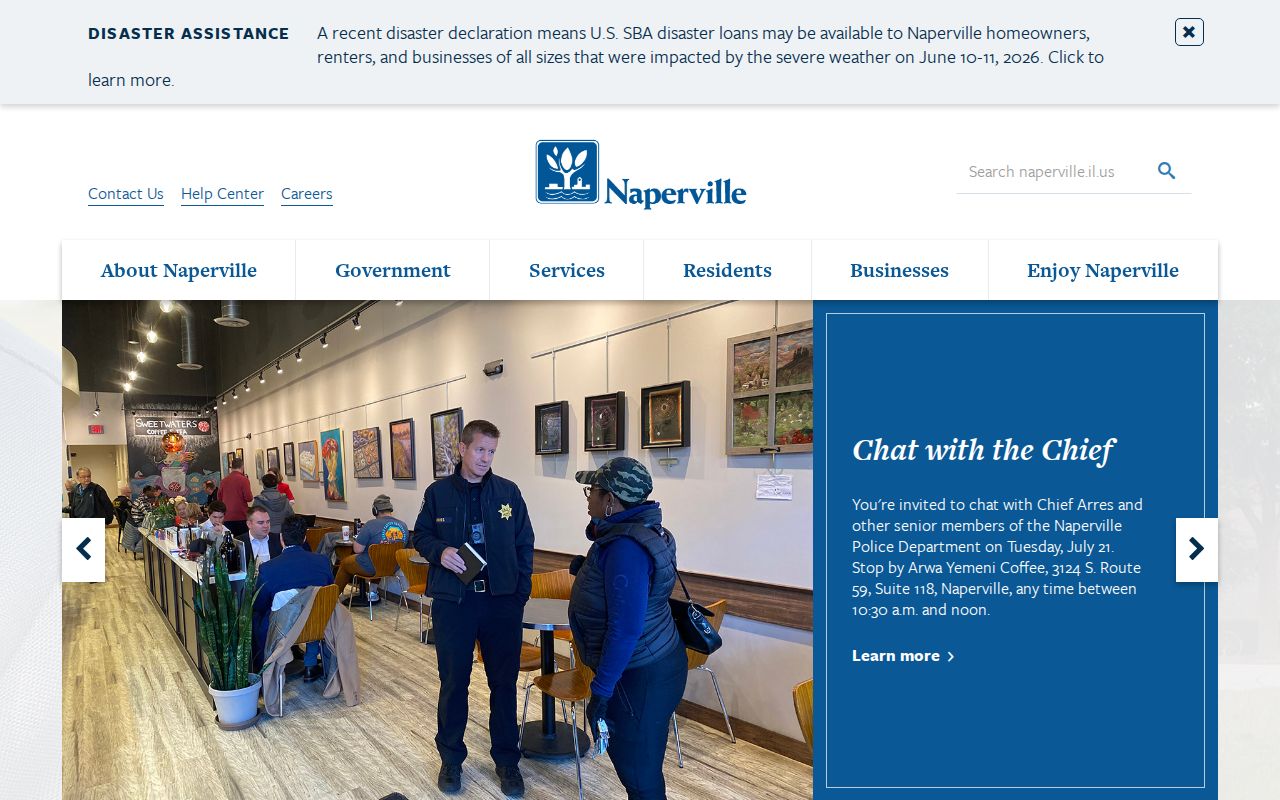
Those city tools answer different questions. A report request seeks an existing NPD file. Online reporting creates a new non-emergency report. A police certificate is a local product, not a complete Illinois transcript.
Request a Naperville Police Report
A focused request through the city's official Naperville FOIA route helps NPD locate and review the right record. Give the requester's contact details, a clear description, date range, incident number, subject or location, desired format and delivery method, any useful attachment, fee acknowledgement, and signature. Request separate material by name when needed. An “incident report” may not naturally include every photograph, recording, dispatch entry, or video held in another format.
Illinois FOIA allows the city to redact material under a specific legal basis, including protected private details or information whose release would cause a listed law-enforcement harm. It does not make all police-created records secret. Ask for non-exempt, reasonably separable portions when part of a Naperville record must be withheld.
The Illinois Attorney General provides official FOIA guidance and Public Access Counselor information.
This state guidance supplies the review path after a denial, while Naperville remains the custodian of its own police report.
Arrests and Bookings in Naperville
An NPD arrest can generate several records. Police write the report. A receiving jail creates booking and custody data. Illinois State Police may receive fingerprints for a reportable event. A circuit clerk opens a case only when a charging document is filed. These records may show different allegations because prosecutors can change or reject the officer's proposed counts.
Check the jail in the correct county for present custody, not for the final outcome. The DuPage Sheriff inmate search applies to current DuPage custody. An absence may mean release, transfer, no booking, a spelling mismatch, or delayed entry. For the court outcome, use the circuit clerk. The dedicated DuPage arrest history page covers the county booking chain without turning allegations into proof.
Note: Naperville Police press releases are selective and describe allegations; they are neither a full arrest log nor a judgment of guilt.
When a Naperville Arrest Looks Missing
A blank DuPage result calls for diagnosis, not a guess. First confirm that the incident took place in DuPage County. Then check whether the State's Attorney filed a case and whether enough time has passed for the clerk entry to appear. Search by full last name, adding first name, middle name, and birth date. If a case number is known, use it before a name search.
Call DuPage Criminal/Traffic at 630-407-8600 when the online check or human-verification screen fails. For a Will-side event, use the Will County custodian instead. NPD can still hold the report when neither circuit court shows a filing. No filing can mean a lag, rejected charges, further investigation, or a wrong jurisdiction. It does not erase the city report.
Naperville First Appearance Records
A DuPage-side Naperville arrest can lead to First Appearance Court after prosecutors file a case. The court addresses rights, counsel, probable cause, and pretrial status as applicable. Under Illinois's current pretrial system, the judge may order release with conditions or detention through the statutory process. A reader should not force that decision into the old shorthand of “posting cash bond.” Historical Naperville dockets may still contain bond terms because they span earlier law.
The clerk's newest signed order controls the formal release or detention status. An NPD release can say that prosecutors sought detention, but a request is not the judge's ruling. Likewise, a complaint lists allegations and charge classes; it is not a conviction. Naperville Police releases expressly preserve the presumption of innocence, a sound rule for reading all recent-arrest notices.
Track the record in sequence. First identify the NPD event and correct county. Next locate the filed circuit case. Then read the first-appearance entry and later orders. A charge may be amended, dismissed, resolved by plea, tried, or otherwise disposed of. When the public index compresses those events into short labels, request the complaint and signed order from the circuit clerk. That keeps the police announcement, prosecutor's request, and court decision in their proper roles.
Naperville Municipal Court Records
Naperville has no separate public municipal criminal-history index that replaces a county circuit clerk. State criminal charges go to the circuit court for the county of filing. Parking, ordinance, or administrative matters may follow a city channel instead. Read the citation and identify whether it supplies a circuit case number or a municipal administrative reference.
| Court Name | No separate Naperville criminal court index; use the correct Illinois circuit clerk for filed state charges. |
|---|---|
| Case Types Heard | State criminal filings belong in circuit court; some parking and ordinance matters may remain administrative. |
| Case Lookup Channel | DuPage Public Information Application for DuPage filings; the Will County clerk for Will-side filings. |
| What the Docket Shows | May include case status, filing details, charges, hearing dates, courtroom, docket events, disposition, and payments. |
| Copies & Fees | Request filed pleadings or certified orders from the clerk that holds the case; verify its current fee page. |
A court complaint proves that an allegation was filed, not that it was proved. Read later docket events and obtain the signed disposition when the legal outcome matters.
Naperville Certificate or Illinois CHRI
A Naperville police certificate and an Illinois criminal-history response have different scope. The city product concerns the local police channel and the terms of that request. ISP's Bureau of Identification maintains the state central repository. A UCIA conviction inquiry follows the prescribed public process, while fingerprint Access and Review is the route for reviewing and challenging one's own Illinois transcript.
| Source | Best use | Main limit |
|---|---|---|
| Naperville Police | Local certificate or NPD-created report | Not a statewide court or repository history |
| Circuit Clerk | Filed charge, docket, order, and disposition | Limited to that circuit's cases |
| ISP Access and Review | One's own fingerprint-linked Illinois transcript and correction form | Does not replace the local narrative or certified court order |
Compare a disputed statewide outcome with a certified disposition. A name-only response risks same-name confusion, while fingerprints offer stronger identity matching.
Where Naperville Records End Up
NPD keeps the city narrative. The correct county court keeps the prosecution file. Reportable arrests and later outcomes should reach ISP under Illinois reporting law. That transfer can take time, and mismatched identifiers or delayed dispositions can create a gap. A missing state outcome should be checked against the court file rather than inferred from the arrest line.
Record flow: Naperville Police Department › DuPage or Will County Circuit Court › Illinois State Police Bureau of Identification
For recent activity, begin with NPD and the receiving jail. For a filed outcome, move to the correct circuit clerk. For one's identity-linked statewide review, use ISP. Each source answers its own question.
Naperville Safety Data Is Not History
Naperville publishes annual police reports, crime statistics, and a Public Safety Data Map. These are useful for studying trends and public activity, not for reconstructing a person's criminal history. Counts must be tied to a reporting year, offense definition, agency coverage, and whether the measure describes incidents, arrests, or clearances.
The official Illinois UCR datasets provide statewide context for careful comparisons.
This dataset view reinforces the difference between aggregate city statistics and an individual NPD, court, or ISP record.
Naperville Online Reports Are Not Searches
NPD's online non-emergency reporting path is for submitting a new report in an eligible situation. It is not a name-search portal, a copy-order service, or proof that a case was filed. Report forms can ask for incident type, occurrence date and time, location, reporting-party contacts, property, and a narrative, with added fields based on the event.
To retrieve an existing record, use Police Records or Naperville FOIA. To locate filed criminal charges, use the circuit clerk. To check present jail custody, use the correct county jail. Keeping those tasks separate prevents a report-submission confirmation from being mistaken for a court docket.
Public Access Rules
Naperville police files and circuit court files do not share one access law. Illinois FOIA governs city agency requests and requires a five-business-day response baseline for noncommercial requests, subject to permitted extensions and other statutory responses. Court clerks follow court-record rules, statutes, and sealing orders. FOIA cannot open a sealed court file.
Key Statutes:
Illinois Freedom of Information Act, 5 ILCS 140 sets agency request procedures, fees, exemptions, denial rules, and review rights.
Uniform Conviction Information Act, 20 ILCS 2635 governs prescribed public access to Illinois conviction information.
Criminal Identification Act, 20 ILCS 2630 addresses repository reporting and expungement or sealing procedures.
Juvenile material, victim details, protected identifiers, sealed records, and information tied to specific law-enforcement harms can be restricted. The custodian should cite the legal basis for a denial and release reasonably separable portions when the law permits.