
How to Check Criminal History in DuPage County
Start a DuPage County criminal history search with the record that answers the actual question. The Eighteenth Judicial Circuit Public Information Application is the main county court index. It offers routes by case number, complaint or ticket information, and party name. It can show status, court dates, docket entries, and payment information, but it does not promise free access to every filed image.
Gather the full last name, first and middle names, birth date, and a case or complaint number when available. Similar names are common, so a name match alone does not prove identity. Note the search date and source, then compare the latest docket event with any booking, police, or Illinois State Police record.
- Use a known DuPage case number first because it is more precise than a name.
- Otherwise enter the full surname, then narrow matches with first name, middle name, and birth date.
- Read the most recent status, docket entry, disposition, and sentence instead of relying on the first charge row.
- Check the Sheriff inmate interface only when present DuPage County custody is part of the question.
- Order the signed court document or certified disposition when the legal effect matters.
- For an identity-linked review of your own Illinois record, use fingerprint Access and Review through ISP.
The official DuPage County government hub routes readers to county departments and records services.
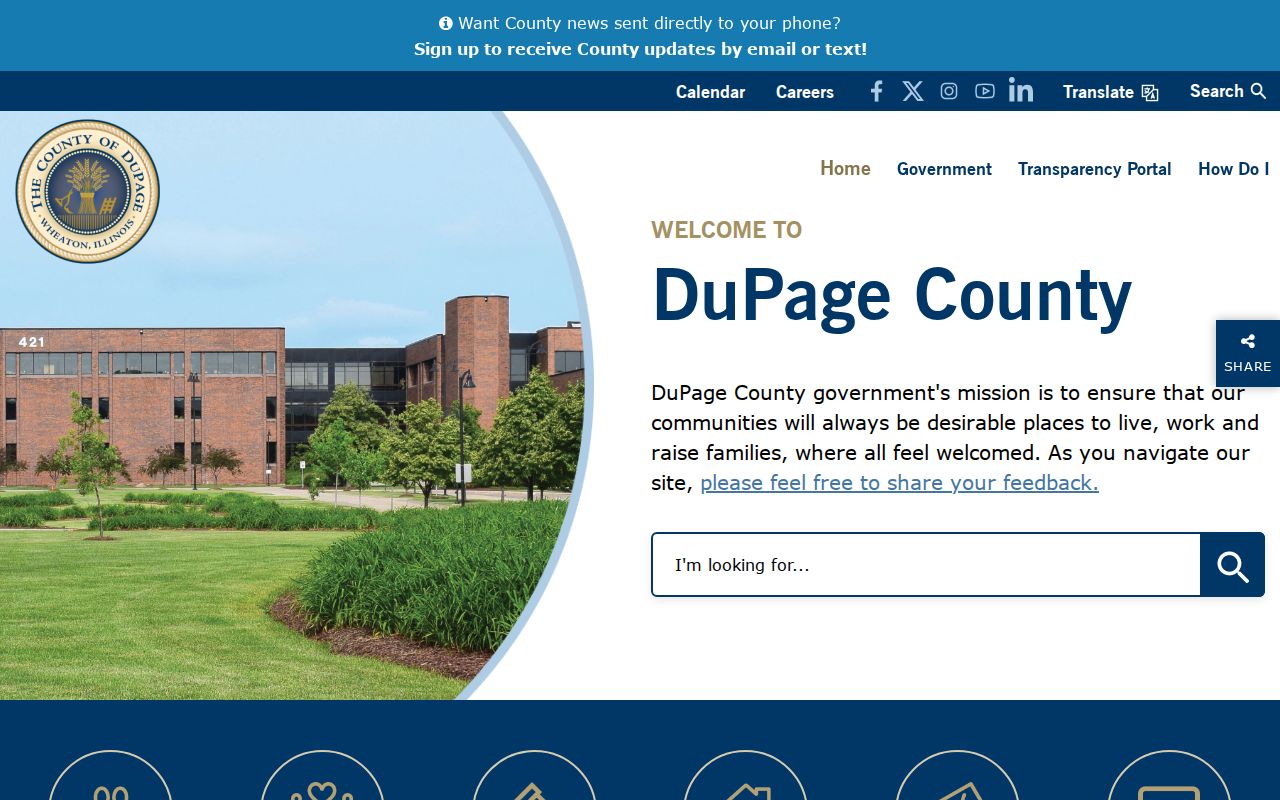
This county landing page helps separate court, law-enforcement, probation, and FOIA channels before a request is sent.
Four DuPage Criminal Records From One Arrest
A single DuPage County event may produce four records that differ without any office being wrong. A municipal police report describes the investigation and alleged conduct. A Sheriff booking entry captures intake, holds, and custody. The Circuit Clerk file begins when a complaint, information, indictment, or citation is filed. An ISP transcript links qualifying, reported arrest cycles with later outcomes.
| Record | Custodian | Best use | Main limit |
|---|---|---|---|
| Incident or arrest report | Creating police agency | Event narrative and evidence categories | May be redacted or still under investigation |
| Booking record | DuPage County Sheriff | Intake and current custody | Not the final charge or outcome |
| Court case | Circuit Clerk | Filed charges, orders, disposition | Does not contain every police file |
| Illinois CHRI | ISP Bureau of Identification | Reported statewide identity-linked history | Timing and disposition matching can create gaps |
If charges were changed or declined after arrest, the court file can disagree with the booking allegation. A missing disposition in state data may reflect reporting delay or an identifier mismatch. The sound response is to obtain the certified disposition, not guess from the oldest entry.
Official Illinois Background Checks
The Illinois State Police Division of Justice Services, Bureau of Identification is the central criminal-history repository. Under the Uniform Conviction Information Act, any person may request Illinois conviction information through prescribed channels. A name inquiry can confuse people with similar identifiers. Fingerprints provide a stronger match, while ISP Access and Review is the subject-only process for seeing and challenging one’s own transcript.
The ISP Bureau of Identification page explains repository products, Access and Review, and record challenges.
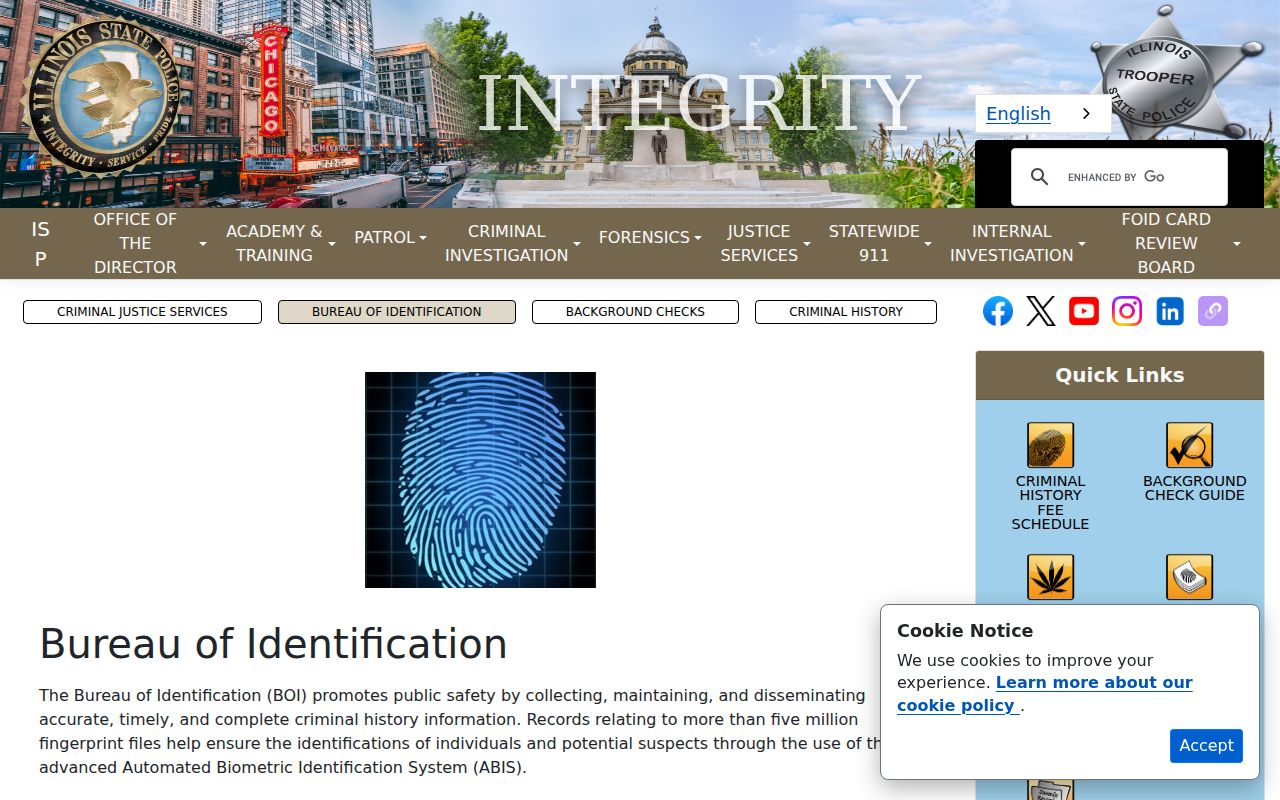
For DuPage County residents, this state layer can connect reported Illinois events outside the county, something the local court index cannot do.
| ISP service | Published ISP fee | What to know |
|---|---|---|
| UCIA name inquiry | $16 paper; $10 electronic | Conviction information; name matching is less reliable |
| Fingerprint-card inquiry | $20 paper; $15 electronic | Vendor capture charges may be added |
| Access and Review | No ISP fee | Subject only; fingerprint vendor may charge |
| Court-order processing | $60 | ISP processing after an expungement or sealing order |
CHIRP Is Not a Casual DuPage Name Search
The Criminal History Information Response Process, or CHIRP, is easy to misread as an open public search box. Its encrypted interface is restricted to agencies and entities with an ISP user agreement. Public UCIA name and fingerprint conviction inquiries begin through an Illinois-licensed live-scan vendor or another approved channel, and a response may be retrieved using its transaction control number.
The official CHIRP entry page shows that authentication boundary.
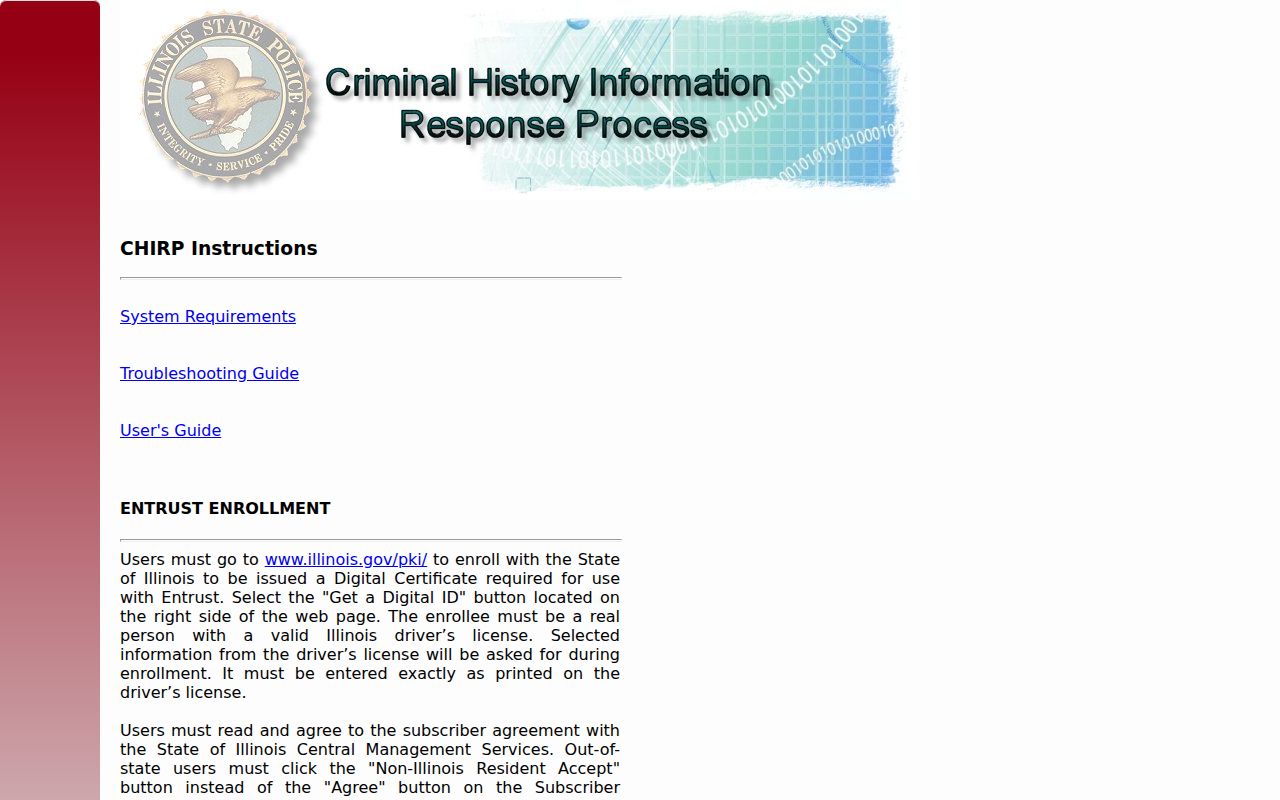
Residents reviewing their own DuPage County criminal history should use fingerprint Access and Review rather than assume the CHIRP login is a public county portal.
Types of Criminal Records in DuPage County
DuPage County criminal records are defined by their creators and purposes. The police narrative, jail intake, filed case, state transcript, warrant, supervision file, and registry entry are related but not interchangeable. Asking the correct custodian avoids a common loop among offices on the Wheaton government campus.
- Incident and arrest reports belong to the Sheriff or municipal department that created them and can contain allegations, narrative, and evidence categories.
- Booking records belong to the Sheriff when a person enters the DuPage Correctional Center and describe custody, not guilt.
- Criminal court case files belong to the Circuit Clerk and show filed charges, hearings, orders, disposition, and sentence.
- ISP criminal-history entries connect reported Illinois arrest cycles and dispositions through repository identifiers.
- Warrant, supervision, and registry records have separate access rules, and many probation details are not public.
Illinois charge classes describe statutory exposure, not the result of a DuPage County case. Ordinary felony ranges run from one to three years for Class 4 through six to 30 years for Class X, while offense-specific rules and enhancements can change them. Class A misdemeanors carry less than one year, Class B up to six months, and Class C up to 30 days. Always read amended counts and the judgment. Detailed local custody sources appear with the DuPage County arrest history, while community-notification records use the separate Illinois registry check.
County Farm Road Has Several Record Custodians
The Judicial Center, State’s Attorney, Public Defender, probation services, Sheriff, and Correctional Center sit on or near the County Farm Road government campus in Wheaton. Physical closeness does not merge their files. The Circuit Clerk keeps pleadings and court orders. The State’s Attorney holds prosecution material but is not the general court-record counter. The Sheriff keeps its law-enforcement and jail records. Probation and Court Services maintains supervision files.
Circuit Clerk, Criminal/Traffic
505 N. County Farm Road, Wheaton, IL 60187
630-407-8600
Weekdays, 8:00 a.m. to 4:30 p.m., excluding court holidays
DuPage County State’s Attorney
503 N. County Farm Road, Wheaton, IL 60187
630-407-8000
Prosecution and victim-service records
DuPage County Sheriff
County Farm Road government complex, Wheaton
Booking, custody, Sheriff reports, and jail operations
The Circuit Clerk and Judicial Center page supplies court access rules and service links.
A courthouse visitor should write down or print the case number because camera-equipped cell phones and recording devices are prohibited in the courthouse.
What a DuPage County Criminal Record Shows
The fields depend on the record. A DuPage court index may show case number, filing date, status, parties, charge descriptions, scheduled dates, docket events, and balances. An Illinois CHRI transcript can connect aliases, demographic descriptors, a state identification number, fingerprint control identifiers, the contributing agency, arrest date, charge codes, court tracking, disposition, and sentence when reported.
| Name & Identifiers | Names, aliases, birth-date fields, SID, FBI, or transaction identifiers when authorized and available. |
|---|---|
| Arrest / Booking Data | Agency, date, alleged offenses, booking number, holds, and release or detention data. |
| Charges & Statutes | Counts, Illinois statute citations, offense descriptions, and classifications at a stated procedural point. |
| Disposition | Dismissal, acquittal, plea, finding, judgment, or other outcome as recorded by the court and reported onward. |
| Sentence | Custody, probation, conditional discharge, court supervision, fines, and other ordered terms where public. |
| Custody / Supervision Status | County jail snapshot, IDOC custody, or public status, not a complete probation officer file. |
DuPage Sheriff Records and Current Custody
The Sheriff is the custodian for deputy reports, Sheriff arrests, county booking material, jail operations, and administrative files it creates. It cannot supply a Naperville, Wheaton, or Downers Grove police narrative, and it cannot replace a signed Circuit Court order. The official inmate interface is best read as a current-custody snapshot. A person’s absence may mean release, transfer, no county booking, a spelling mismatch, or an update delay.
The DuPage County Sheriff website is the official starting point for corrections and Sheriff-created records.
For a municipal arrest, request the incident report from the city police department and any separate booking material from the Sheriff.
No complete public countywide warrant database was verified. To resolve your own possible warrant, check the court docket, call Criminal/Traffic with the case number, contact the issuing court and Sheriff through official channels, seek legal advice, and obtain a filed recall or quash order when applicable.
Public Access Laws for DuPage County Criminal Records
Illinois FOIA governs requests to executive agencies such as county offices and police departments, while court access follows clerk procedures, court rules, statutes, and sealing orders. A FOIA request cannot bypass a sealed case. For police material, ask for electronic, non-exempt portions and give the incident number, date range, location, record type, and desired format. A public body ordinarily responds to a noncommercial request within five business days, though a lawful extension, clarification, redaction, denial, or no-record response may follow.
Key Statutes:
20 ILCS 2635 makes conviction information public through prescribed UCIA procedures.
20 ILCS 2630/2.1 and /5 set criminal-history reporting duties, while section 5.2 governs expungement and sealing.
5 ILCS 140/3, /6, /7, and /9.5 cover requests, fees, exemptions, denials, and Public Access Counselor review.
730 ILCS 150 establishes Illinois sex-offender registration duties.
730 ILCS 152/115 authorizes the statewide Internet database and community notification.
The ISP criminal-justice statutes resource explains the repository’s reporting framework.
That reporting layer helps explain why an arrest event and later DuPage County court disposition must be matched through shared identifiers.
Search the DuPage Criminal Case Portal Precisely
The DuPage Public Information Application has three entry routes. Use the case-number route when a filed number is known, the complaint route for ticket or complaint details, and the party route when only a name is available. A human-verification screen can block automation, and a failed automated query does not show that the case is absent.
| Field | When to use it | Search caution |
|---|---|---|
| Enter Case Number | Known DuPage filing | Most precise route |
| Complaint Number | Paper ticket or complaint | May also require arresting agency |
| Full Last Name | Party-name search | Do not assume partial-name or wildcard behavior |
| First and Middle Name | Narrowing same-name results | Spelling and aliases still matter |
| Birth Date | Identity narrowing | Portal shows MM/DD/YYYY format |
| Search Type | Choose Person or Organization | Select the correct party type |
When the application does not work in a normal browser, call Criminal/Traffic at 630-407-8600 or use the public counter. Search access is free, but document copies are ordered separately through i2File and can carry statutory copy and certification charges.
Sealed, Expunged & Restricted
Illinois expungement generally destroys or returns qualifying arrest and court records, while sealing blocks ordinary public access but preserves access for specified justice and statutory purposes. Eligibility depends on every arrest’s result and the person’s whole record. Acquittals, dismissals, releases without charge, reversed or vacated convictions, and some supervision outcomes may qualify for expungement. Many convictions may qualify for sealing, but exclusions and waiting periods require a case-specific review.
Use the Illinois Courts forms for a Request to Expunge and/or Seal, the case list, any additional-arrests form, a proposed order, and service materials. File in each county where a record arose. DuPage County filings go through the Circuit Clerk. ISP and the arresting agencies may receive notice and object, and a judge may hold a hearing. Juvenile and cannabis relief follow separate provisions and forms.
Note: A dismissal does not erase a DuPage booking entry unless the legal expungement process reaches each covered custodian.
DuPage Jail, Illinois Prison, or Federal Custody
Custody searches answer different questions. The DuPage Sheriff inmate search concerns present county custody and is the right first stop after a recent local booking. The IDOC Individuals in Custody search concerns people in state custody after an Illinois sentence and can show public custody or status fields. Federal prison information belongs to the Bureau of Prisons, while federal case filings route through PACER and the Northern District of Illinois.
- County booking
- Intake at the DuPage Correctional Center, often near the start of the case.
- Pretrial release or detention
- A court-ordered status under Illinois’s current system, which replaced routine cash-bail assumptions.
- IDOC custody
- State correctional custody after a sentence, not the county jail roster.
- Mandatory supervised release
- State supervision administered by IDOC; it is not the same as county probation.
- Probation
- Circuit-court supervision through DuPage Probation and Court Services, with many case details restricted.
A disappearance from the Sheriff search often signals release or transfer, not record deletion. Check the newest court order for legal status and use IDOC only when state custody is plausible.
Read DuPage Criminal Record Statistics by Year
Aggregate crime data should never be treated as a list of people or as proof about a neighborhood. ISP Crime in Illinois and ICJIA datasets can distinguish reported offenses, arrests, and clearances. Results depend on the year, agency coverage, population measure, reporting changes, and offense definition. DuPage County’s fragmented municipal map makes those labels especially important because city police, the Sheriff, and other agencies report separately.
The ISP Crime Reporting Program publishes the official statewide reporting context.
Use the publication year and agency definition beside any DuPage County count, and do not mix a Census total from one vintage with a crime measure from another without clear labels.
DuPage Warrants and Police Reports Need Fallbacks
No complete, reliably indexed DuPage County warrant database was verified. A docket can show a failure-to-appear or warrant event, but later recall or quash activity may change its effect. For your own possible warrant, confirm the case with the Clerk, contact the issuing court and Sheriff, obtain legal advice before appearing, and keep the filed recall or quash order. A sealed warrant will not appear publicly.
Police reports remain with the agency that created them. Under Illinois FOIA, identify the incident, date, location, report number, desired format, and specific categories. Ask separately for an incident narrative, arrest supplement, CAD chronology, 911 audio, body-camera footage, or photographs because one request label may not capture systems stored apart. The first 50 black-and-white letter or legal pages are free for a noncommercial request, and later pages may cost up to $0.15 each. Court documents follow Clerk copy charges instead.
Criminal Records by City in DuPage County
Municipal police create their own incident and arrest reports, while the Sheriff keeps county-jail bookings and the Circuit Clerk keeps filed state criminal cases. The ranked city set uses municipalities principally associated with DuPage County: Naperville, Wheaton, and Downers Grove. Naperville crosses into Will County, so incident location determines which jail and circuit clerk apply. Aurora’s DuPage portion is excluded because Aurora is principally associated with Kane County.
Naperville Criminal History
2020 population 149,540 · Start with NPD, then identify the DuPage or Will side of the incident.
Wheaton Criminal History
2020 population 53,970 · City police, Sheriff booking, and Circuit Clerk records retain distinct custodians.
Downers Grove Criminal History
2020 population 50,247 · Village reports route through Downers Grove FOIA; filed cases route countywide.
Correct Your Own DuPage Criminal History
When an Illinois transcript lacks a DuPage County disposition or links an event to the wrong identity, begin with ISP fingerprint Access and Review. An Illinois law-enforcement or correctional facility, or an IDFPR-listed licensed fingerprint vendor, captures and submits the fingerprints. ISP sends the transcript and a Record Challenge form, or a no-record letter. ISP does not charge for Access and Review, though the vendor may charge for capture and transmission.
Compare the transcript with a certified DuPage disposition. Identify the exact arrest cycle, contributor, charge, outcome, or identity field that is wrong and send the supporting court or agency record through ISP’s challenge process. A county portal result alone is weaker support than the signed order. If the error is in a police report rather than the state transcript, contact the creating agency under its correction and records procedures.